
Required Items in the Order
Required Items is a venue setting that allows you to require certain products to be included in an order. The venue can specify which product categories must be represented in the order, as well as the minimum quantity and/or total value of products from those categories. For example, you can configure a rule requiring at least 1 pizza or 2 burgers in an order. If none of the rules is met, the system will prevent the customer from placing the order and display a message explaining which products need to be added. This feature helps prevent situations where customers meet the minimum order value by purchasing only drinks, desserts, and other supplementary products without ordering the venue’s main products.
1. Key Principles
- Rules are configured separately for each venue. If no rules are configured, orders can be placed as usual.
- Rules are enabled using the “Require products from categories in the order” toggle. If the toggle is disabled, the rules remain saved but are inactive. They become active again when the toggle is enabled.
- Multiple rules work on an “OR” basis: the customer only needs to meet one of the rules.
- For each rule, you can specify a minimum quantity, a minimum amount, or both. A value of 0 means that the corresponding parameter is not restricted. If both values are specified, both conditions must be met simultaneously.
- The quantity and amount are calculated only for products in the selected category, not for the entire order.
- Products in subcategories are also included. For example, a rule for the “Pizza” category also applies to products in the “Pizza → Meat” subcategory.
- Products for which the selected category is set as an additional category are also included.
- The amount is calculated using regular product prices, including modifiers (add-ons), before discounts, promotions, and promo codes are applied. Packaging costs are not included.
- Promotional gifts are excluded from both the quantity and amount calculations.
- The rules apply to all order types placed by customers on the website and in the app, including delivery and pickup.
- A rule is inactive if its selected category is hidden or deleted, or if its parent category is hidden. If no rules remain active, no restrictions are applied.
- Rules are checked during checkout. Customers can add any products to their cart, but they cannot place an order until they meet at least one active rule.
- Required items are checked before the minimum order amount. If neither condition is met, the customer will first see the message about required items.
- Changes apply to new orders after the settings are saved. Existing orders are not affected.
||| Important! This feature does not replace the minimum order amount configured for a delivery zone. The minimum order amount is configured as before, while required items serve as an additional condition.
| Please note: The “Required Items” page is available only if the account’s subscription plan includes this feature and the user has permission to edit the venue. If the feature is removed from the subscription plan, the rules for all venues in the account are disabled but remain saved.
2. Configuring Required Items 2.1. How to Open the Settings
- In the Control Panel, go to “Companies”.
- Open the required venue.
- In the venue menu, go to “Order Settings” → “Required Items”.
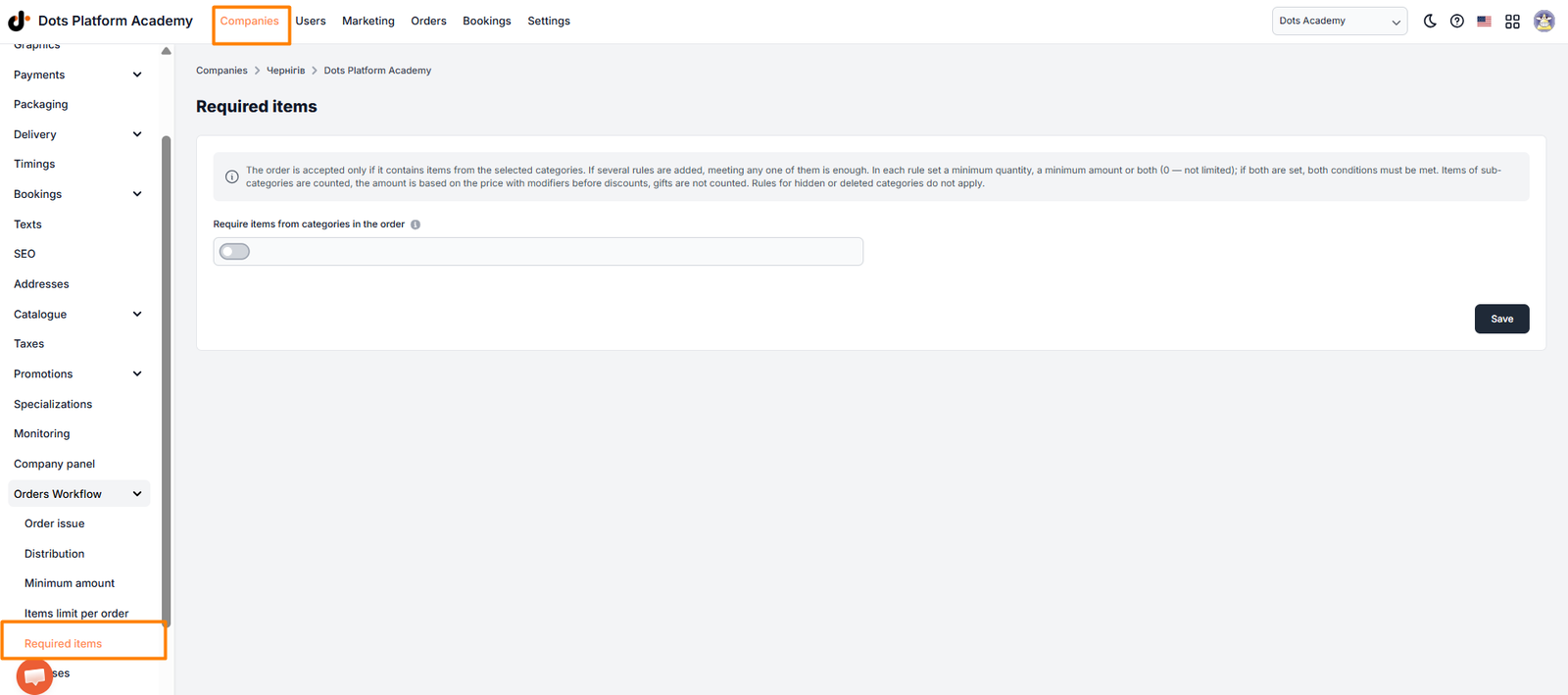
2.2. How to Add a Rule
- Enable the “Require products from categories in the order” toggle. Rule rows and the “Add” button will appear below it.
- Click “Add” to create a new row.
- In the “Category” field, select the required category. Subcategories are displayed together with their parent categories, for example, “Pizza → Meat”. To find a category, enter part of its name.
- In the “Minimum Quantity” field, specify how many products from this category must be included in the order. If quantity is not a requirement, leave the value at 0. If the field is cleared, it will automatically be set to 0 after saving.
- In the “Minimum Amount” field, specify the minimum total value of products from this category. If the amount is not a requirement, leave the value at 0. If the field is cleared, it will automatically be set to 0 after saving.
- Add more rules if needed. Each rule has its own row.
- Click “Save”.
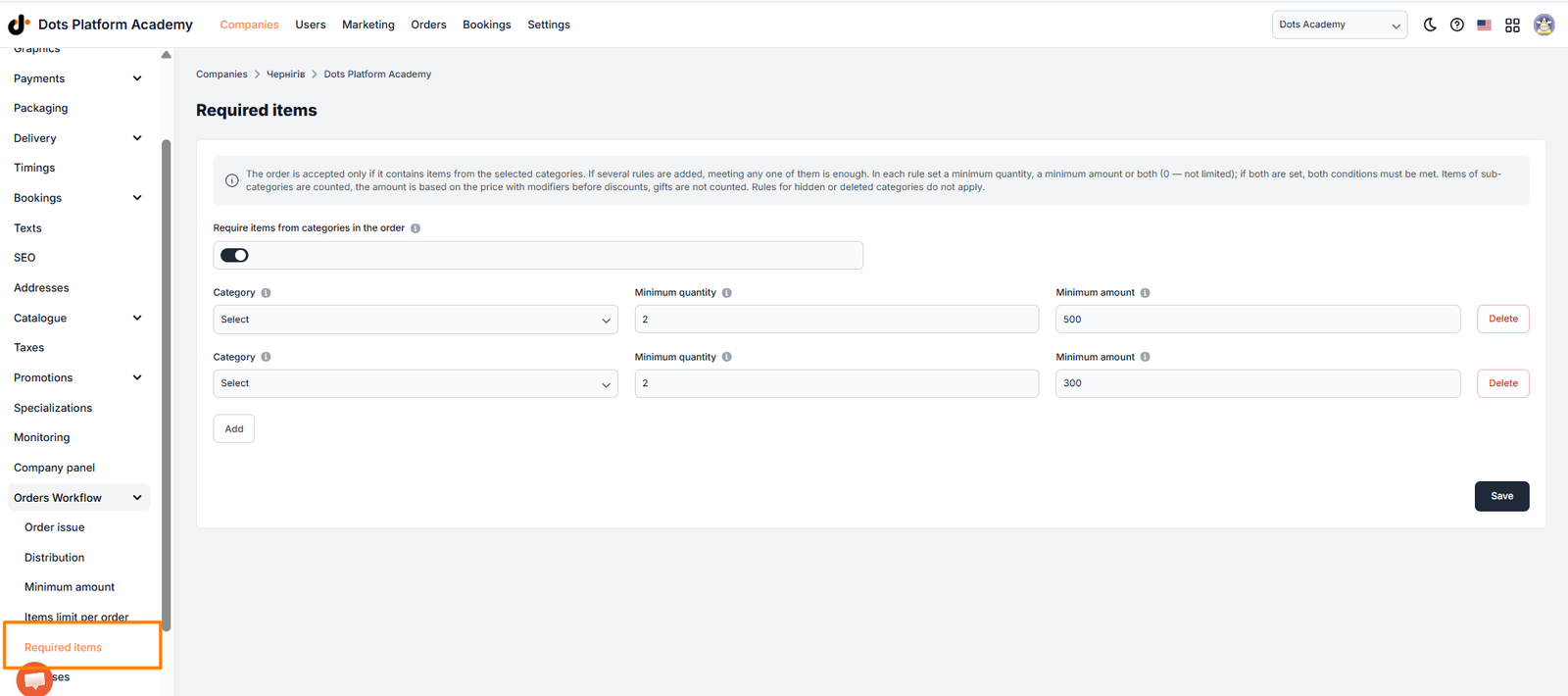 | Important! Each rule must have a minimum quantity, a minimum amount, or both specified. If both values are 0, the rule will fail validation when you try to save the settings.
2.3. How to Edit or Delete a Rule
- Open the “Required Items” page for the relevant venue.
- To edit a rule, change the category, minimum quantity, or minimum amount in the corresponding row.
- To delete a rule, click “Delete” in that row.
- Click “Save”.
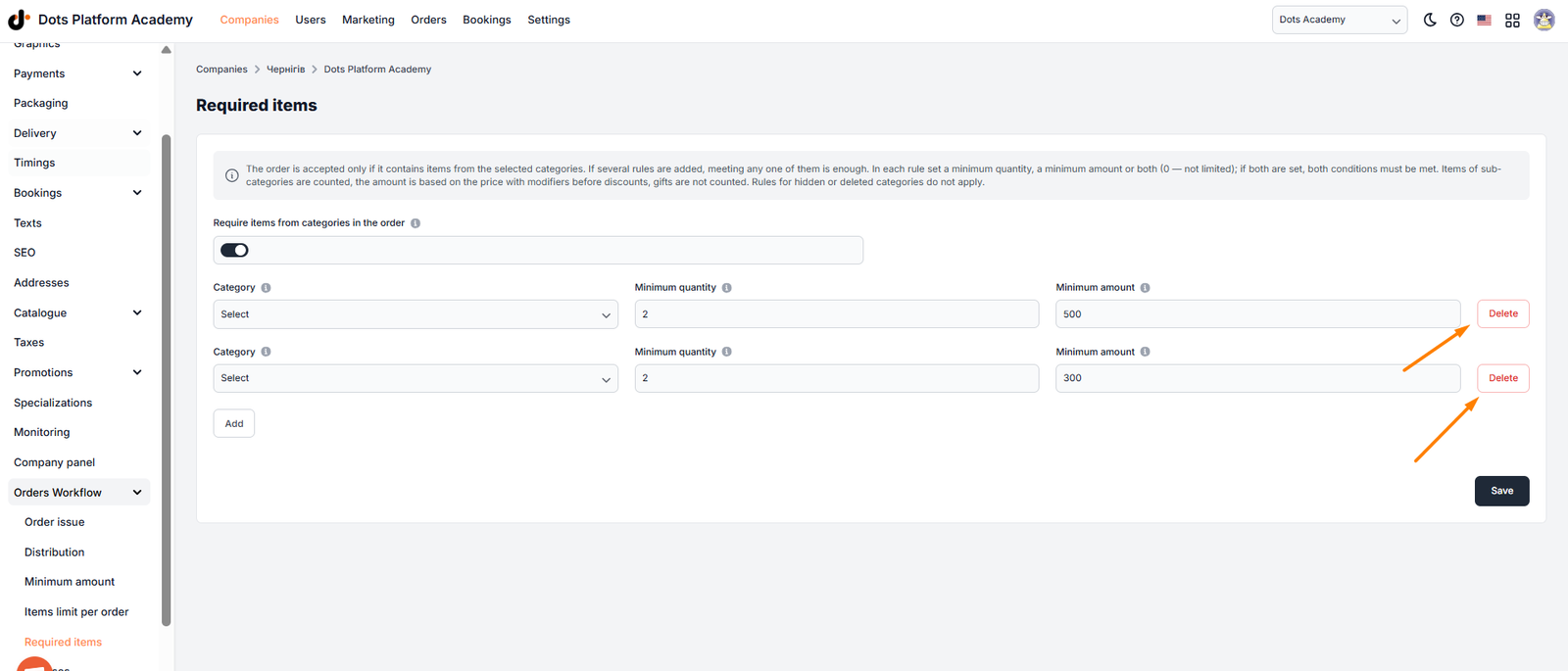 || Please note: Changes are applied only after you click “Save”.
2.4. How to Temporarily Disable Rules
- Open the “Required Items” page for the relevant venue.
- Disable the “Require products from categories in the order” toggle. The rule rows will be hidden.
- Click “Save”.
The configured rules will not be deleted. To activate them again, enable the toggle and click “Save”.
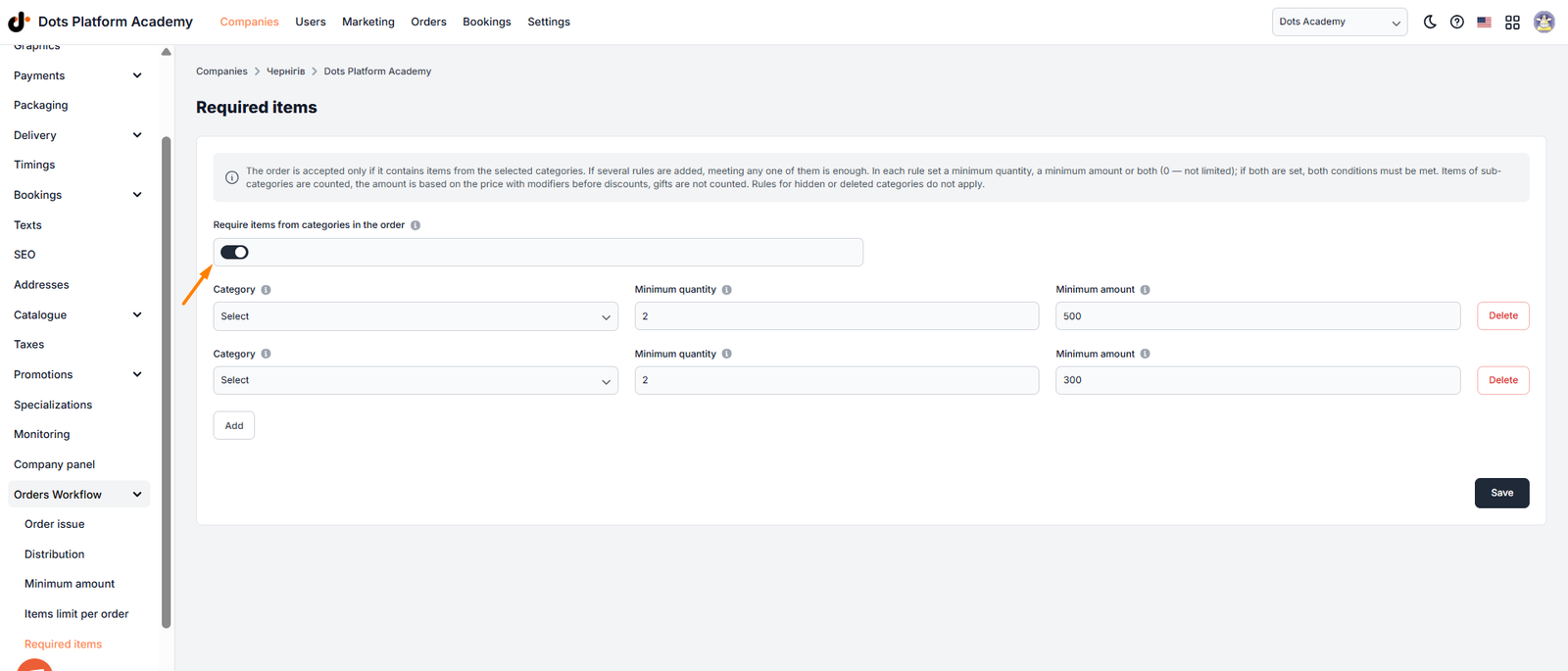
| Important! If you change any rules before disabling the toggle but do not save those changes, they will not be saved.
3. Page Elements
3.1. The “Required Items” Page
The top of the page contains an information block with a brief feature description and a toggle. When the toggle is enabled, the list of rules configured for the venue appears below. Each row represents one rule.
- “Require products from categories in the order” — enables or disables rule validation. When disabled, the rules remain saved but are inactive.
- “Category” — the venue category whose products must be included in the order. All categories are available, including hidden ones. Deleted categories are not displayed. Subcategories appear in the “Parent → Child” format.
- “Minimum Quantity” — the minimum number of products from the selected category, including its subcategories. Allowed whole numbers range from 0 to 100. A value of 0 means that quantity is unrestricted.
- “Minimum Amount” — the minimum total value of products from the selected category, in the account’s currency. Allowed whole numbers range from 0 to 1,000,000. A value of 0 means that the amount is unrestricted.
- “Add” — adds a new, empty rule row.
- “Delete” — removes the corresponding rule row.
- “Save” — saves all rules on the page. If the quantity or amount field is cleared, it will automatically be set to 0 after saving.
Settings Validation
When the toggle is enabled, the system will not save the settings if:
- No category is selected in a row.
- Both the minimum quantity and minimum amount are 0 or empty. Both fields will be highlighted, and the hint “Enter a quantity or amount” will appear below them.
- The minimum quantity is less than 0 or greater than 100.
- The minimum amount is less than 0 or greater than 1,000,000. If a category with a configured rule is deleted, its row will disappear from the page. The rule will be permanently deleted after the next save. If a category is only hidden, the rule will remain in the settings but will be inactive until the category is enabled again.
3.2. What the Customer Sees
If none of the active rules is met during checkout, the order will not be created. The customer will see a message describing the available options for meeting the requirements. Example message: “To place your order, add at least 2 products from the ‘Burgers’ category with a total value of at least UAH 420, or at least 1 product from the ‘Pizza’ category.” The message is displayed in the language the customer uses on the website or in the app. Quantity wording is adjusted to the number, for example, “1 item”, “2 items”, or “5 items”. Depending on the rule settings, the message may include:
- Minimum quantity only: “At least 1 product from the ‘Pizza’ category.”
- Minimum amount only: “Products from the ‘Pizza’ category worth at least UAH 300.”
- Both minimum quantity and amount: “At least 1 product from the ‘Burgers’ category worth at least UAH 420.”
Once the customer adds the required products to the cart and meets at least one active rule, they can place the order as usual.
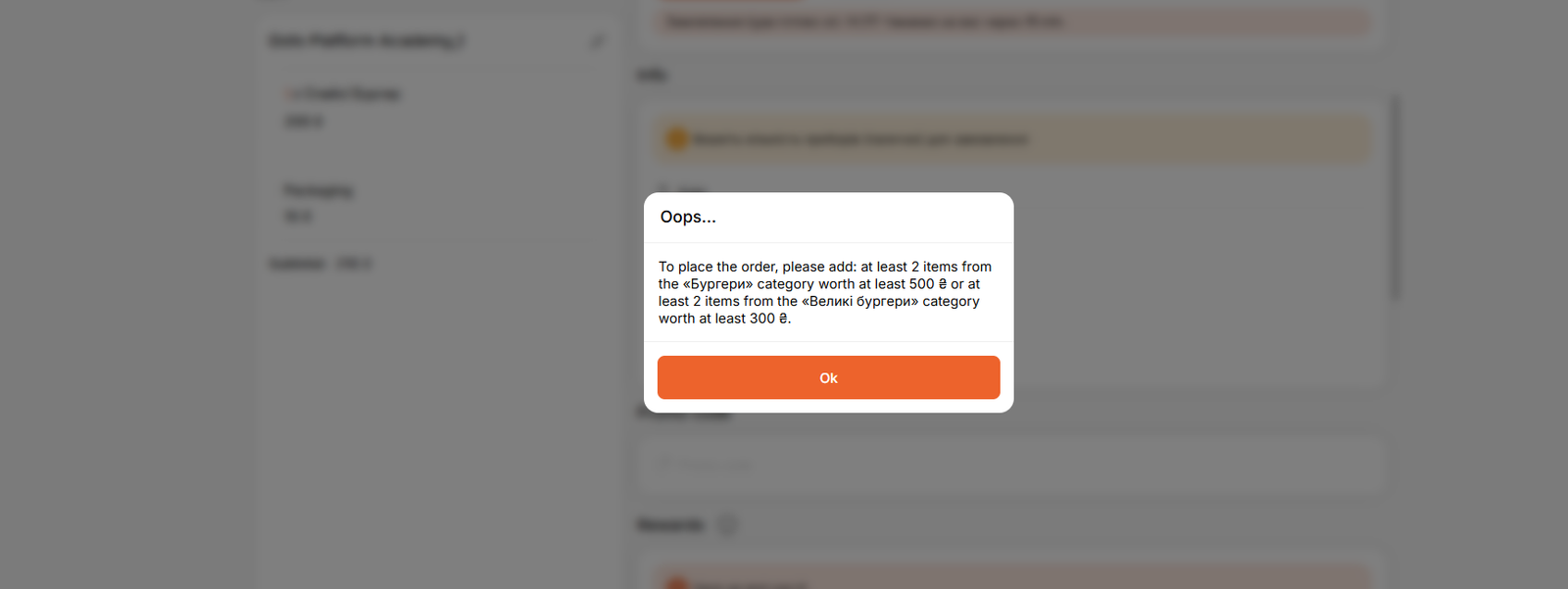
| Please note: There is no preliminary notification about required items in the cart. Customers see this requirement only during checkout.
4. Examples and Recommendations
- Pizzeria. Rule: “Pizza” category, minimum quantity — 1, minimum amount — 0. An order containing only drinks and desserts will not be accepted. An order containing any pizza will meet the rule.
- Several options for main products. Rules: “Burgers”, minimum quantity — 2; “Pizza”, minimum quantity — 1. The customer only needs to order either 2 burgers or 1 pizza.
- Minimum quantity and amount. Rule: “Burgers”, minimum quantity — 1, minimum amount — UAH 420. One burger priced at UAH 400 does not meet the rule. The customer must add products from this category with a combined value of at least UAH 420.
- Minimum amount only. Rule: “Sushi”, minimum quantity — 0, minimum amount — UAH 500. The rule is met if the total value of sushi is at least UAH 500.
- Modifiers. A burger priced at UAH 400 with UAH 30 worth of add-ons is counted as a product worth UAH 430. Therefore, it meets a rule requiring a minimum amount of UAH 420 for the “Burgers” category.
- Discounts. If a burger costs UAH 500 and has a 50% discount, it is still counted at its regular price of UAH 500 when the rule is checked. Discounts do not reduce the amount counted toward the rule.
- Promotional gift. A free pizza received through a promotion does not count toward a rule requiring at least 1 product from the “Pizza” category. The customer must add a pizza to the order separately.
- Copying a venue. When a venue or its catalog is copied, the rules are copied along with the categories and linked to the corresponding categories in the new venue. If the catalog is copied as inactive, the rules will start working once the categories are enabled. We recommend checking the rules after copying.
| Tip: Inform customers about required items in advance, for example, in the venue description or on a banner. This helps customers understand the requirements before checkout.
5. Frequently Asked Questions
The customer cannot place an order and sees the message “To place your order, add…”. What should they do?
The order does not contain the required products, or the quantities do not meet the rules. The customer needs to add products from the category specified in the message and meet the conditions of at least one rule. If the venue wants to change the requirements, edit or delete the relevant rule.
The customer added a burger, but still cannot place the order. Why?
The rule may specify both a minimum quantity and a minimum amount, and the total value of burgers in the cart may be below the required amount. The amount is calculated only for products in the selected category, not for the entire order.
Are discounts and promo codes included in the rule amount?
No. The amount is calculated using regular product prices, including modifiers, before discounts, promotions, and promo codes are applied.
Are promotional gifts included?
No. Promotional gifts are excluded from both the quantity and amount calculations.
Are products from subcategories included?
Yes. A rule for a category applies to products in that category and all its subcategories.
A rule is configured but does not work. What should I check?
Make sure that:
- The “Require products from categories in the order” toggle is enabled.
- The category selected in the rule and all its parent categories are active.
- You clicked “Save” after making changes.
- The account’s subscription plan includes the feature. Rules associated with hidden or deleted categories are inactive. If the feature is removed from the subscription plan, the rules for all venues in the account are disabled but remain saved.
Can I configure a rule only for delivery or for a specific delivery zone?
No. The rules apply to all order types and all venue addresses. The minimum order amount for a specific delivery zone can still be configured separately, as before.
Why is the “Required Items” menu option missing?
The page is available only if the account’s subscription plan includes the “Required Items” feature and the user has permission to edit the venue. The page is located under “Order Settings” in the venue menu. The “Order Settings” section itself is displayed if the subscription plan includes at least one feature available in that section.
Why is a category missing from the “Category” list?
Deleted categories are not displayed in the list. Check whether the category belongs to the correct venue and whether it has been deleted.
Do the rules affect orders that have already been placed?
No. Rules are checked only when a new order is placed. Existing orders are not affected.
Was this article helpful?
Thanks for your feedback!